Cybersecurity / Application Modernization
PHP2Shell Vulnerability: Patch Now, Plan Your PHP to .NET 10 Migration
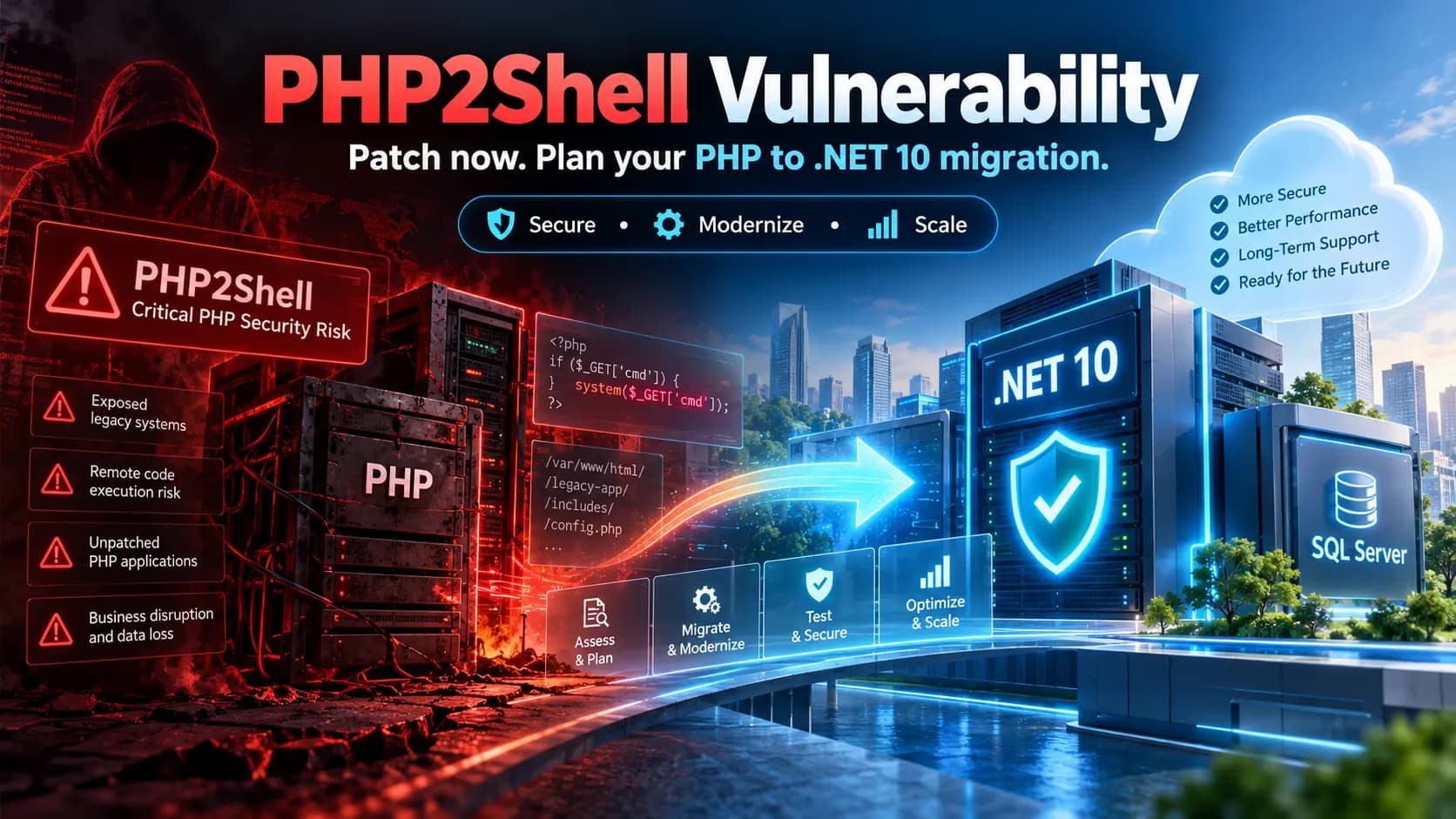
PHP2Shell is a critical PHP remote code execution flaw. Patch your PHP servers now, then learn when a phased PHP to .NET 10 migration makes business sense.
- Published
- 5 min read
- Application Modernization
- Current PHP security risk
- Immediate protection
- Safe modernization
- Future-ready business application
- PHP Security
- PHP2Shell
- .NET 10
- ASP.NET Core
- Application Modernization
- SQL Server
On this page
On October 21, 2026, the PHP project released urgent security updates for two critical flaws nicknamed PHP2Shell. If your business runs a PHP website, portal, or internal application, patch it today. Then ask whether your application is built to stay secure for the years ahead.
What Is PHP2Shell?
All PHP installations serving web requests are at risk, including PHP-FPM, Apache with mod_php (the highest-risk setup, per the advisory), php-cgi, FrankenPHP, and LiteSpeed. Security firm watchTowr reports exploitation in the wild since October 21.
You may see headlines saying PHP2Shell affects "70% of the internet". That reflects PHP's usage share, not the number of hacked sites. It means every organization running PHP needs to confirm it is patched.
What You Should Do Today
Your PHP2Shell response checklist
Find every PHP installation
Include web servers, containers, staging servers, and products that bundle PHP, such as control panels and CMS platforms.
Patch and restart
Update to a fixed release or your vendor's patched package, restart all PHP workers, and confirm the version actually running. Start with internet-facing systems.
Use temporary mitigations only as a stopgap
If you cannot patch today, apply the advisory's mitigations and restrict access. PHP states these reduce risk but do not make a server safe.
Check for signs of compromise
Review logs, unexpected files, new accounts, and unusual outbound traffic on any server that was exposed.
Running PHP 8.1 or older? These versions no longer get official releases. PHP 7.4 to 8.1 have source patches or vendor packages, but PHP 7.3 and older, including PHP 5, have no fix. If upgrading PHP breaks your application, the real problem is not one bug. It is an application that has become hard to keep secure.
Patch, Then Decide: Maintain or Modernize?
Not every PHP application needs to be migrated. Use this guide once you are patched.
PHP application running today
Patched against PHP2Shell
Security and application assessment
Key decision
Is the application supported, maintainable, and meeting business needs?
Path A, if yesMaintain and secure PHP
When: the application is healthy, on a supported PHP version, and actively maintained.
Keep PHP and dependencies updated
Strengthen security controls
Add tests and monitoring
Path B, if noPlan .NET 10 modernization
When: the application is stuck on old PHP, uses abandoned components, or slows the business down.
Document existing business logic
Design ASP.NET Core architecture
Migrate and test module by module
Deploy with monitoring and rollback
Secure, maintainable, business-ready application
Why .NET 10 for Modernization?
PHP is not inherently insecure, and well-maintained PHP applications can be sound. For business-critical systems handling money, health records, or personal data, many organizations choose ASP.NET Core and .NET for:
- Predictable support: .NET 10 is a Long Term Support release, supported until November 14, 2028 under the official .NET support policy.
- Built-in security: identity, multi-factor authentication, policy-based authorization, data protection, and anti-forgery features.
- Safer code: strongly typed C#, parameterized database queries by default, and package vulnerability checks during builds.
- Strong data protection: SQL Server features such as Always Encrypted, Row-Level Security, and auditing (availability depends on edition).
No platform is immune to vulnerabilities. The real value of migration is a modern, tested application that is easy to patch.
How Aplombsoft Migrates PHP to .NET 10 Safely
We avoid big-bang rewrites. Where the architecture allows, we use the Strangler Fig approach: a routing layer sends traffic to new ASP.NET Core modules one at a time while your PHP application keeps running the rest.
Our phased migration process
Step 1: Secure
Patch and assess
We help you patch PHP2Shell, then map your PHP versions, dependencies, data, and business rules into a clear roadmap.
Step 2: Design
Plan the .NET 10 architecture
We design ASP.NET Core security, APIs, and the database strategy, including MySQL to SQL Server migration where it fits.
Step 3: Migrate
Move modules in phases
High-value modules go live one at a time, with URLs and integrations preserved where needed.
Step 4: Validate and deploy
Test, then go live with care
Each module is tested by our QA team for functionality, security, and data integrity, then deployed with monitoring and a rollback plan.
Not every application suits incremental migration, and database changes need their own rollback planning. Our assessment tells you honestly which approach fits.
Frequently Asked Questions
If we plan to migrate, do we still need to patch PHP now?
Yes. Patch immediately. Migration is a longer-term project, and your current servers must be secure while it happens.
Will our application go offline during migration?
With a phased approach, your existing application usually keeps running while modules are migrated. Final cutovers are planned for low-traffic periods, and any expected downtime is agreed in advance.
Can we keep using MySQL?
Yes. .NET works well with MySQL and PostgreSQL. SQL Server is worth considering when you need features like Always Encrypted or advanced auditing.
We use WordPress. Does this apply to us?
Yes. WordPress runs on PHP, so your server's PHP must be patched. Many businesses keep WordPress for marketing content and move portals, billing, or member areas to a secure .NET application.